
How to Provide Health Insurance For Your Remote Employees

What happens when an employee falls down the stairs? Or when they get an acute infection? Or get diagnosed with cancer? Or when they aren’t feeling well and want to get things checked, just to be sure?
All of these things can happen anywhere.
But if they happen outside your home country, this may pose extra challenges. Often it’s necessary to contact your international insurance company immediately, consult them on which hospitals are covered and which aren’t, consider the huge difference between public hospitals and private clinics, assess the quality of medical care, and maybe even consider repatriation.
Providing cost-effective health insurance for your employees is challenging, especially if your employees are scattered around the globe. With the possibility of people working remotely, along comes the need for global health insurance that will cover your team wherever they are.
International Health Insurance for Business

Times are changing. Your employees aren’t in the same office space as you anymore. You may think differently about hierarchy than your ancestors. You may put more emphasis on trust instead of control. Globalization is embraced more, and remote-first hiring has gone from a novelty to a standard way of building a team.
While you may find yourself in the same office as always, your employees might be at home in their pajamas while getting work done.
Or opening their laptop on a lounge chair in Cancun. More and more people desire to live like digital nomads, and more people make this a reality. The possibilities are plentiful. There are known cases of people bringing their home plants on a road trip to Spain to keep up appearances during a Teams meeting.
There are various reasons for employees to be abroad. Work may require them to go on business trips. Or it may require them to live abroad for a while. They may need to be in another country for family reasons. Your employees may require the freedom to be wherever they like. Or you may purposely hire people from foreign countries.
For companies, hiring remote employees is an effective way to bring down costs, of labor or office rental.
Why International Employees Need Their Own Coverage
Being uninsured carries risks, the worst of which is being unable to afford health care exactly when it’s needed. For an employee working abroad, that risk is sharper than it would be at home: an employer-provided domestic plan often stops covering treatment the moment someone crosses a border, and a national healthcare system only covers residents physically living in that country. Neither one travels with the employee.
Being in a foreign country also raises the stakes on ordinary risk. Road safety, healthcare quality, and disease exposure all vary enormously by country. An employee posted to a country with limited trauma care or a higher risk of tropical disease is taking on real exposure your standard benefits package was never built to cover.
Tropical diseases have serious consequences. And you can hardly blame an employee who visits a doctor for a rash in a country where the local wildlife includes something worth worrying about.
The Differences Between Insurance For Local and International Employees

National health coverage rarely travels well. A public health system almost always stops covering someone the moment they’re no longer physically resident in that country, it’s not a discounted or capped rate abroad, just no coverage at all. Private domestic insurers vary: some reimburse overseas care up to what they’d pay for the same treatment at home, others don’t cover it abroad either.
This means that if you get treated for a broken leg in Switzerland and the costs are higher than in your home country, you need to pay the difference yourself. Some insurance companies don’t provide coverage abroad at all. So for anyone spending time abroad, appropriate insurance is a necessity.
An important distinction is inpatient versus outpatient expenses.
Inpatient expenses are when a patient is admitted to the hospital and needs to stay the night. Inpatient care often involves serious problems that require attention, like major surgeries. Daytime surgeries also count as inpatient expenses.
When treatment can be given inside but also outside the hospital, it’s counted as outpatient expenses. Among outpatient care are visits to a physiotherapist or nutritionist, but also blood tests, casts for a broken leg, and medication. Many insurance companies offer outpatient care abroad only for an extra premium.
Of course, the cost of health care varies enormously by country. A basic diagnostic test at a rural clinic can cost next to nothing in some countries. But if the same employee ends up needing an ambulance to a private hospital equipped to treat something serious, like cerebral malaria, the bill looks nothing like the diagnostic test did.
And before you get a check for common problems like acne, back pain or kidney stones in countries like Norway or Austria, you may want to see the costs.
Even when cheap health care is available, locals may not be willing to help foreigners in facilities that are targeted at locals.
Sometimes taxi drivers and medical personnel will direct foreigners to the most expensive health facilities for expats. This is especially a problem in Asia, where shame over the quality of medical care will stop foreigners from being admitted to public hospitals, whether rightful or not.
Local Insurance, a Stipend, or International Insurance?
If all of your employees reside in the same country for a longer period of time, without any travel, then local insurance is a solution. But for most employers, the solution isn’t that simple. Also, with global insurance companies, there’s the added benefit of easy communication and English-speaking call centers that are open 24/7.
One way to tackle insurance for your remote employees is to provide a stipend. There are companies that specialize in this alongside broader international-employment services: Pebl (formerly Velocity Global, which itself acquired the once-popular Shield GEO) is one, offering a health stipend alongside payrolling, tax, and work permit help for international employees.
Providing a stipend has several downsides. Reimbursing employees for every single treatment isn’t very time-effective. Alternatively, providing an allowance is subjected to tax.
When an employee needs serious treatment that falls outside the allowance, this may create a disagreement on who’s responsible for the costs. Also, with the allowances for all remote employees combined, there’s the risk of paying much more than your company would for an insurance premium. To have your employees covered in a less costly and more secure way, get international health insurance.
Which Health Insurance Plans Are Available For Remote Employees
AIG
If the business that you work in carries significant health risks, then AIG’s Group Accident and Health coverage might suit you. This plan is focused on providing coverage for injuries that an employer is liable for. It also comes with coverage for general medical emergencies, but the downside is that this is rather bare-boned. It covers emergencies.
The advantages are that this trustworthy American company has been around for ages and that it covers anything from small companies to multinationals.
UnitedHealthcare
If your remote team requires more comprehensive health insurance, then consider UnitedHealthcare Global’s Expatriate Insurance. Just like they do on a national level in the US, UnitedHealth also provides health insurance on an international level.
UnitedHealthcare’s plans are expensive, but many treatments are included, even access to wellness programs. Among the optional extras are life insurance and disability insurance. This makes them more appealing to business that carries risks, like the oil and gas industry.
The downside is that their plans are expensive, to get an idea of the costs you need to request a personal quote. Another downside is that their customer service has a bad reputation for the speed and manner in which they deal with claims and questions from customers.
IMG
Another insurance company that offers very comprehensive coverage is IMG, through The Global Employer’s Option. It isn’t cheap, but it includes many forms of medical treatment. Another advantage is that it’s available starting from two employees.
Though IMG’s insurance can be used by businesses worldwide, its service is directed mainly at Americans. This makes it an attractive plan for small American businesses that need extensive coverage.
Allianz

A company that offers insurance both for small and medium-sized enterprises (SMEs) and larger companies is Allianz Care.
Their plans are modular: a Core plan covers in-patient and day-care treatment, with outpatient, maternity, and dental available as add-ons. It’s possible to get a team insured starting from three employees, and for larger groups Allianz can split the team into sub-groups with different levels of cover rather than forcing everyone onto the same plan.
The Core plan alone is competitively priced, but costs rise once you start adding outpatient care, maternity, or dental. Contact their sales team directly for a group quote and to confirm current payment terms, the specifics of what’s bundled versus optional have changed over the years.
SafetyWing
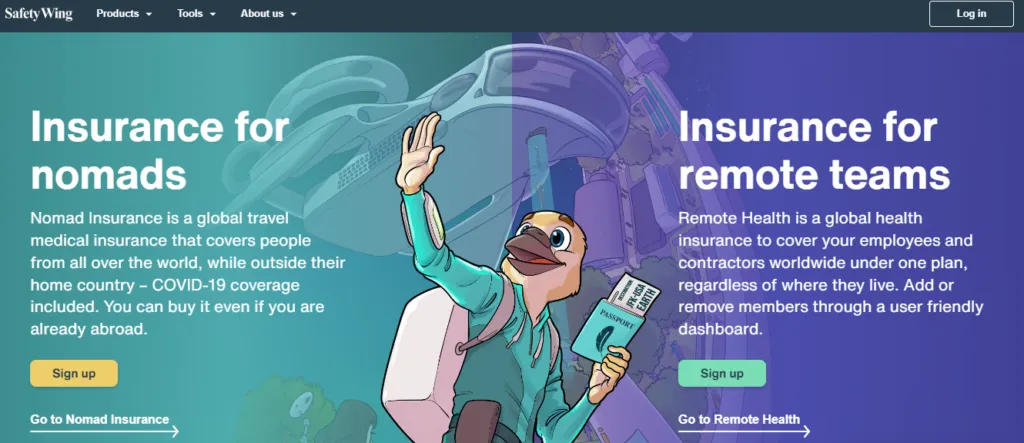
A cheap way in is SafetyWing’s Remote Health program: Standard plans start at $116/month per member (age 18–39), with Premium ($175/month) and Premium Plus ($224/month) tiers adding more wellness, dental, vision, and maternity coverage. It’s billed per member and paid monthly, which is an attractive option for small businesses. One thing worth knowing before you sign up: Remote Health is business-only (even a single freelancer has to enroll as a one-person plan rather than getting an individual policy), and group pricing (a 40% discount) only kicks in once you have 5 or more members.
SafetyWing is a relatively young company, but it gets good reviews and has an easy sign-up process. A downside: repatriation is only covered following a medical evacuation, and there’s no separate option to get broader repatriation coverage.
The Best International Health Insurance For Business
Comparing the options to get health insurance for your remote team, the best choice depends on the level of coverage you want to provide and the demographics of your team. If you want the basics covered for the best price, then get SafetyWing’s Remote Health plan.
Consider adding at least outpatient care as an extra. If you want a more comprehensive plan that provides a broader range of coverage, but still doesn’t go crazy on the price, then get Allianz Care with the outpatient extra.
If you want to make sure that every form of health care is covered for your employees and costs don’t matter, then contact UnitedHealthcare Global.
Consider the age of your employees. Statistically, dental problems increase when age goes up. International dental care is a relatively expensive extra but worth considering in the case of a large percentage of older employees.
If these employees are working in Africa, consider paying for dental care out of hand because it’s cheap in Africa, and in case of non-emergencies, there is cheap but good quality dental care available in most African capital cities.
If most of your employees are in Asia, make sure to get outpatient treatment covered. Many places in Asia have an increased risk of traffic accidents and things like casting a broken leg are often seen as outpatient care, even in hospitals.
Consider the amount of women among your employees and their age. Pregnant employees are less likely to return to their home country to give birth when it’s already covered by their international health insurance package.
Every insurance company has a different kind of strategy for offering competitive coverage. Whether you prefer a comprehensive package without having to think it through, or a stripped-down basic plan that allows you to choose add-ons, is up to you.